Your scholars already record their classes. Halaqa turns each recording into a synced transcript, a study guide, Arabic terms in plain English, flashcards, a mind map and an audio recap within the hour, and gives every student Rafiq AI, a companion that answers only from your cohort's own material and cites the minute.
Free for students to start · One monthly fee per school · Live in a week with the recordings you already have
Here to study? Find your school or study on your own.
Your school already has a website, admissions, tuition and a student portal. Halaqa is not another one of those. It is what happens after the class is recorded: the place where students actually study it, ask about it, and work through it together before they reach the teacher.
If your recordings live on DeanDesk, Halaqa syncs them from your portal automatically. Otherwise a coordinator uploads the file or pastes the link. Either way, nothing about how your scholars teach has to change.
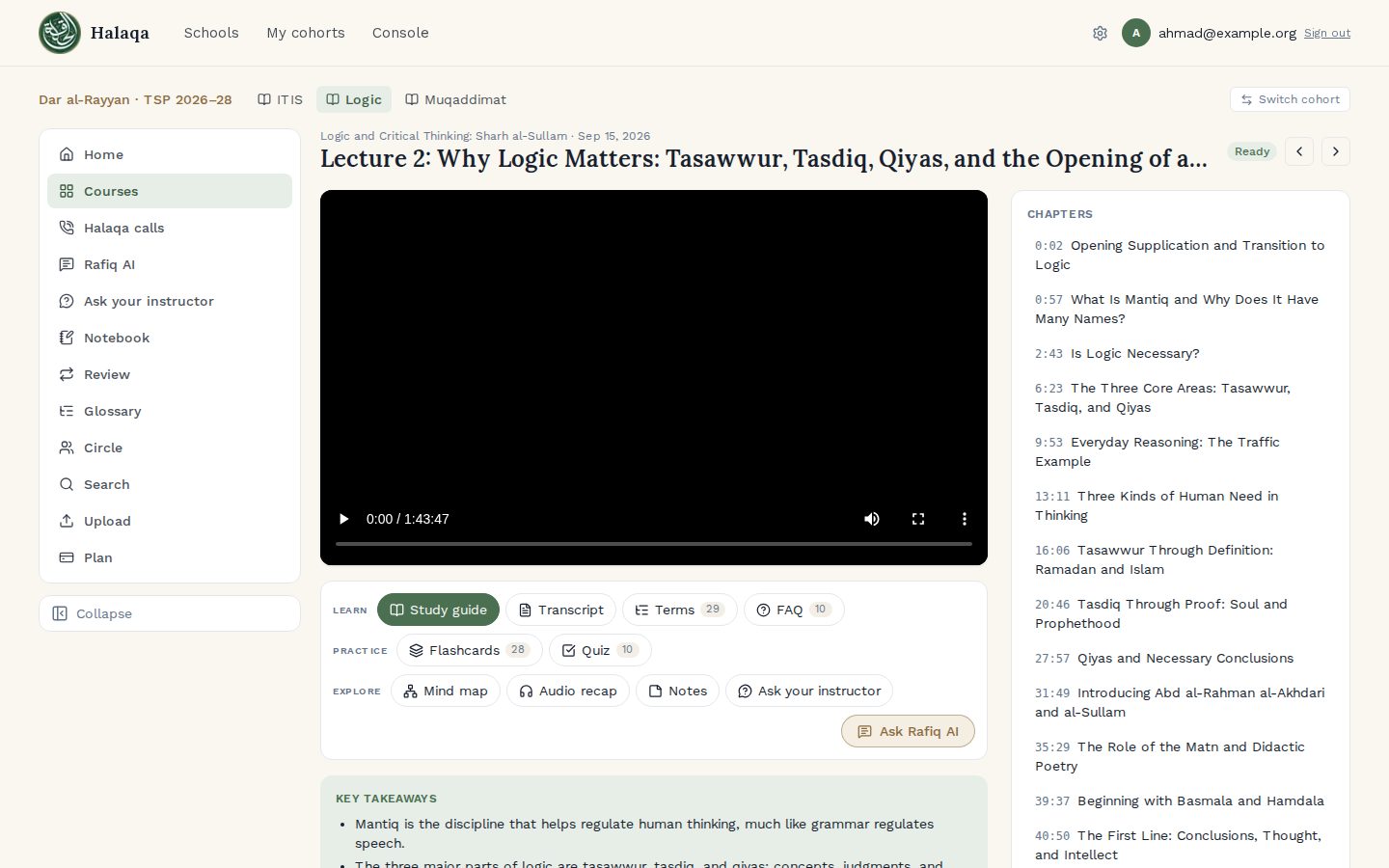
Within the hour, every student in the cohort has the same set of study material, built from the recording itself. The same engine reads scanned Arabic texts and handwritten notes.
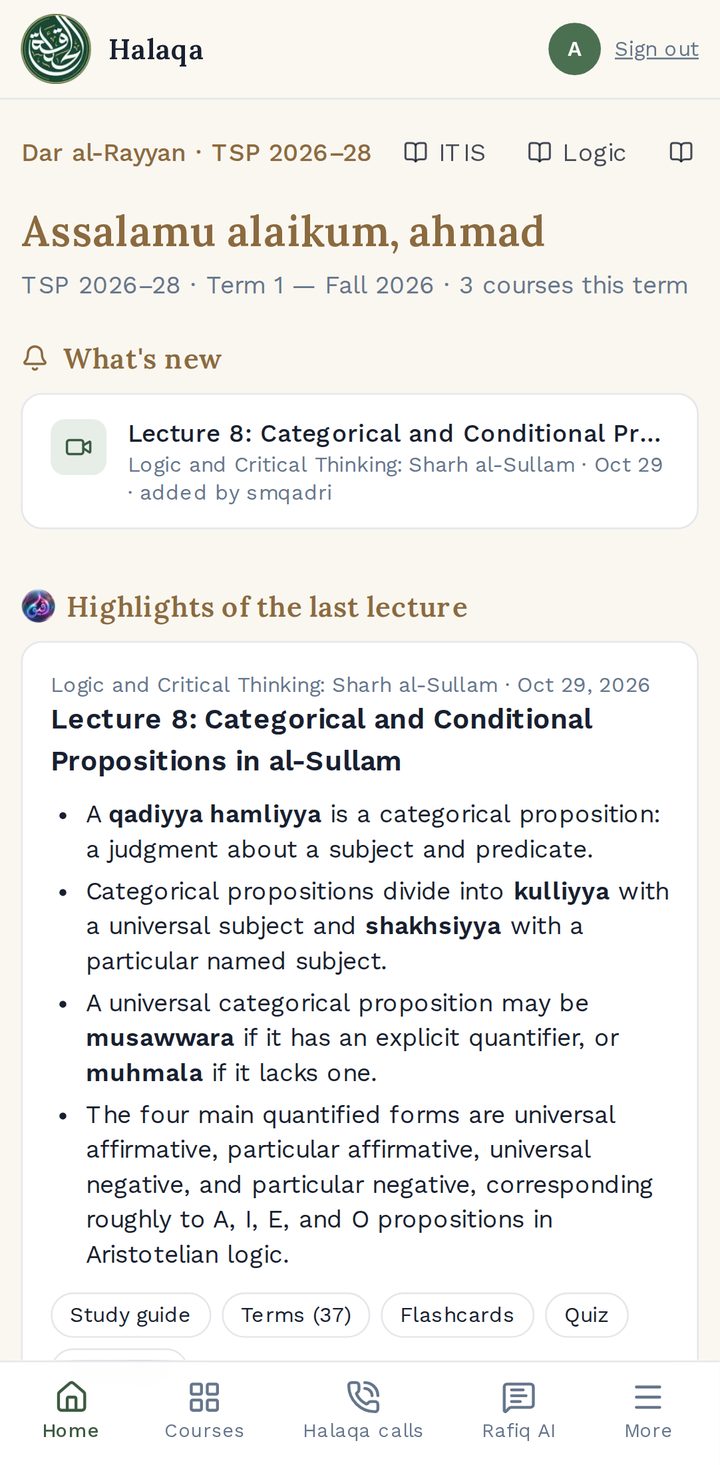
The transcript scrolls with the video. Chapters jump to any point in a two-hour class. The guide opens with the key takeaways.
Every technical term with the script, the transliteration, the meaning as the teacher used it, a familiar parallel, and a link to hear it in context.
Practice material written from the lecture, a map of its shape, and a two-host audio recap with Arabic read by a native Arabic voice.
A scanned matn or sharh is recognised and translated page by page; Arabic and English sit side by side, searchable across both.
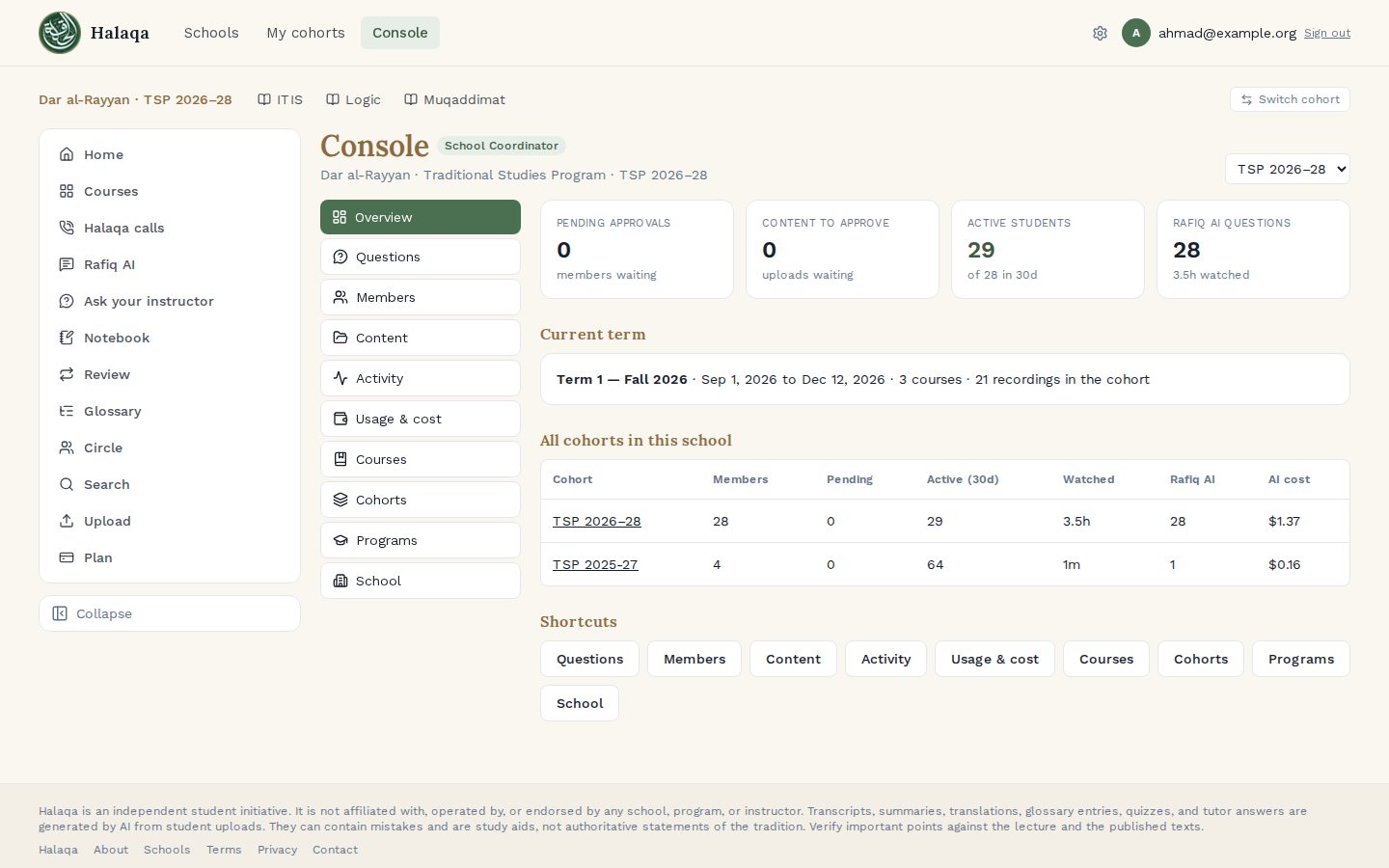
Photograph paper notes and the handwriting is recognised and summarised. Draw on a tablet. Import Notion, Zoom, Evernote, Word or PDF.
Installs from the site on iPhone, iPad, Android, Windows and Mac. Notifications for new lectures, calls and answers. Optional offline reading.
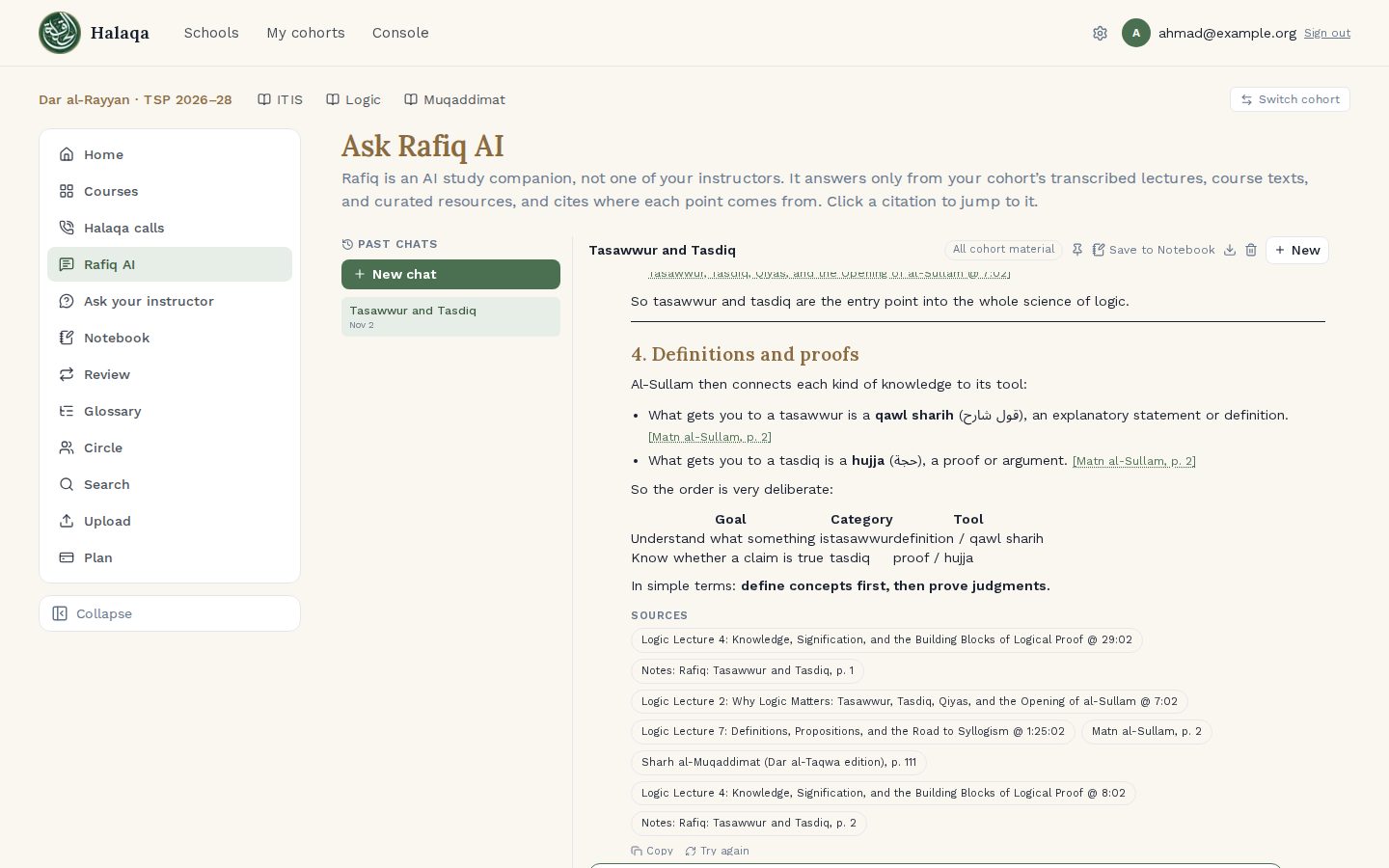
Ask Rafiq anything about the lectures and texts. It answers only from your cohort's transcribed lectures, course texts, curated resources and the student's own notes. Every claim carries a citation: a lecture and a timestamp, or a text and a page. Click it and the video jumps there. If it is not in the material, Rafiq says so, and it will not give rulings: it sends the student to the instructor.
Students vote on what needs a live session, meet in the browser, keep their own notebooks, and work through hard questions together. The teacher receives one prepared question instead of five half-formed ones.
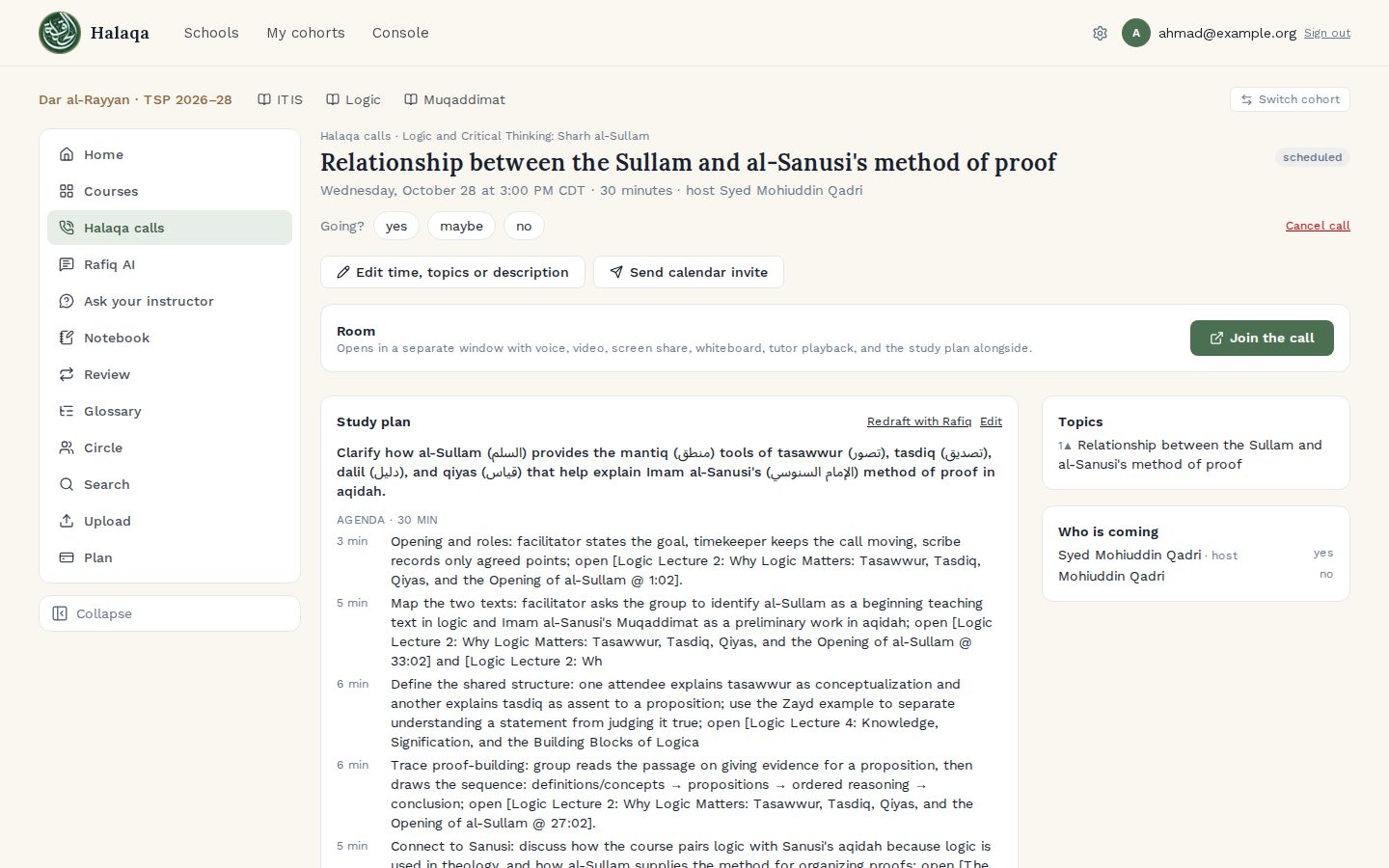
Vote on topics, schedule, let Rafiq draft a time-boxed study plan, then meet with voice, video, screen share, a shared whiteboard and shared playback of any lecture. Attendance and a summary follow.
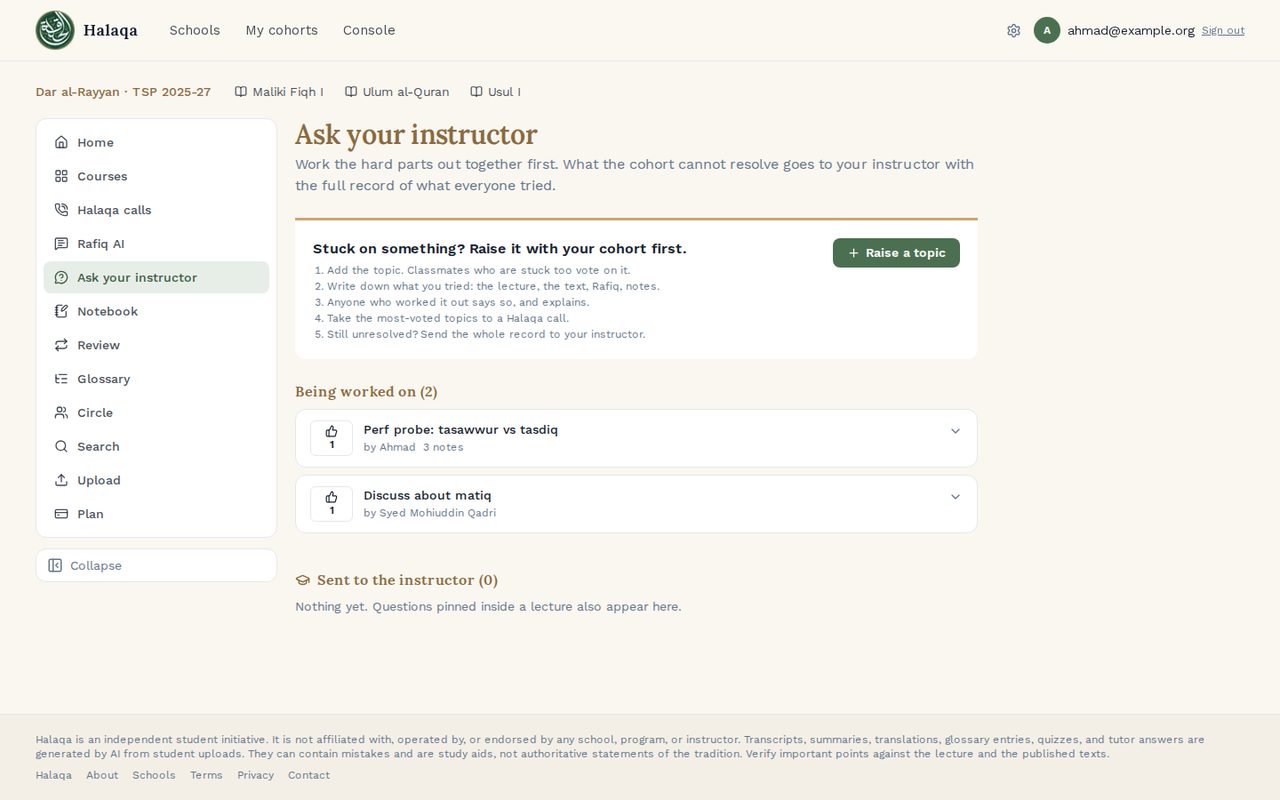
A funnel, not a form. A student raises a topic; classmates vote that they are stuck too; notes are logged; a call is held. Only then does the question reach the teacher, with the whole record attached.
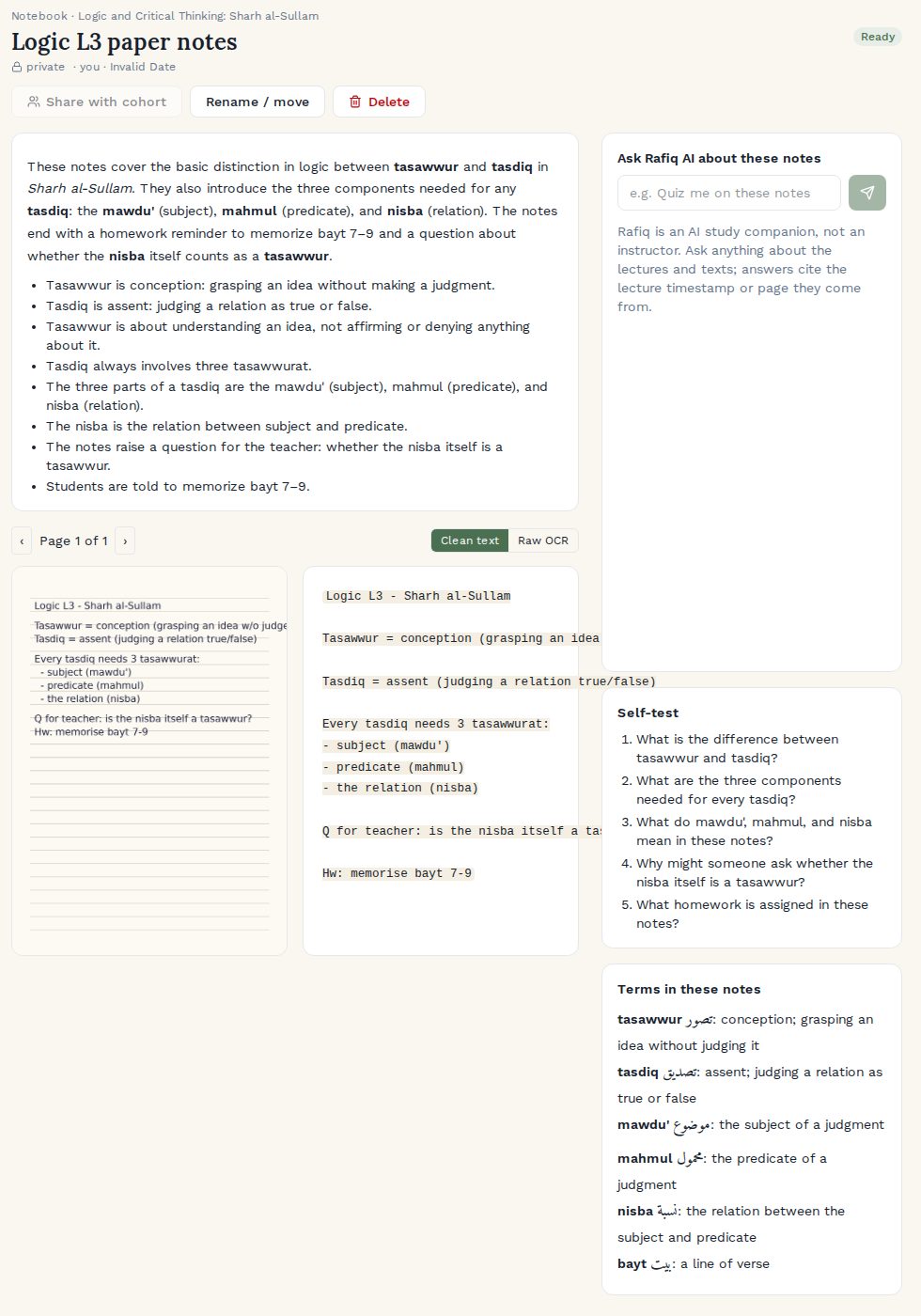
Discussion threads per lecture, notes anchored to timestamps, shared flashcard decks, and a cohort that chips in together for the collaborative tier.

Knowledge, devotion, service. Al-Maqasid is a Muslim seminary in Macungie, Pennsylvania, dedicated to facilitating the realization of Islam, Iman and Ihsan through immersion in the prophetic inheritance: a three-year full-time seminary, a madrasa for children, an academy for grades 7–12, weekend and summer retreats and outreach seminars.
Your link to the connected chain. The online portal of the Safina Society: learn Islam from scholars, online, anytime, anywhere. Live classes on Zoom with recordings, in the Essentials, Advanced and Arabic tracks, the Ibn al-Salah hadith program and the Sanusi Tradition in the rational sciences.
Dar al-Rayyan is an online and in-person teaching platform providing access to traditional Islamic knowledge through programs suitable for all levels. This is the students' independent study space for its programs.
Dedicated to teaching and research on godliness and the religion of Islam in modern life. A two-year hybrid seminary in aqidah, fiqh, tafsir, hadith and tazkiyah led by Shaykh Khalis Rashaad, plus a free course on Shaykh Ahmad Zarruq's Usul al-Tariqah.
“Eight weeks into the term, our cohort had 21 lectures, six classical texts and 700 glossary terms fully studyable, without the teachers preparing a single page. The first time a student clicked a citation and the video jumped to the exact minute, the room went quiet.”
Everything runs in our own private Azure tenant in the United States. Each school is a separate tenant, and the cohort is the unit of privacy: every read is filtered by school and cohort on the server, so nothing crosses cohorts, even inside one school.
Search, Rafiq and every page carry the school and cohort. A student in one cohort cannot see another's lectures, notes or questions.
A private notebook or chat never reaches another student's search or Rafiq answers. Leaders can remove a shared note but cannot read a private one.
Language, speech and document models run inside the same tenant under enterprise terms. Your lectures, prompts and answers are not training data.
Page views, plays, searches and admin actions are written to a two-year audit trail the school can see. Nothing is sold, shared or used for advertising.
Students can start free. Schools pay one monthly fee and every student in their cohorts is covered.
Everything your cohort uploads, with a monthly Rafiq allowance.
The full study companion for one student.
When the cohort's seats are funded, everyone in it gets:
AI credits: $5 per million tokens, never expire. Instructors, cohort leaders and coordinators always have the full plan at no cost. Billing is handled by a merchant of record; Halaqa never sees card details.
Every student on the full plan, with the console.
The whole school, every cohort, your branding.
For institutions with a written data agreement.
Pay monthly, cancel any time. Annual billing: two months free. Extra students beyond the cap: $6 per student per month. The school pays and every student in its cohorts is covered; student plans do not apply while a school plan is active.
Tell us the school, the program and the first cohort. We create your page, invite your coordinators and instructors, and the recordings you already have are studyable within the hour. The first Halaqa call usually happens in week two.
Recordings, texts, and resources on this platform are uploaded by students for their own study and shared only within their cohort. Uploaders confirm they have the right to share them.

 Rafiq cited Logic L2 @ 7:02